

Sony Kd 55 Xg 8096 Test
Test Results
Market place Context
The X800G is an entry-level 2019 LED TV from Sony. It's the directly replacement for the 2018 XF8096 Series Boob tube, which was never released in N America, and is very similar to the X750F. Its main competitors this yr are the Samsung RU7100, TCL 6 Serial R617, and the Vizio 5 Series 2019.
Design

Curved No
The Sony X800G has a great design. It looks almost identical to last yr's X750F, merely with a matte black stand instead of a silver one. The stand supports the Idiot box well, but does wobble a bit, and the legs are nearly the same width every bit the Boob tube and tin't be reversed. The back of the Goggle box is plain, and at that place is only minimal cable management through the back of the feet. The Idiot box has skilful build quality, and we didn't notice any bug or areas of business organisation with our unit of measurement.

The stand supports the TV well, but doesn't forbid it from wobbling. It's nearly the full width of the Tv, then you'll need a broad table if you aren't planning on wall mounting it. The anxiety tin't be reversed to relieve space.
Footprint of the 55" model: 39.0" 10 13.two"

Wall Mount VESA 200x200
The back is plain, merely appears well-built. Similar the X750F, at that place is only basic cable direction, through a hollow department on the back of each foot. Some of the inputs are down-facing in a cut-out on the back, and they might be difficult to access when wall-mounted.
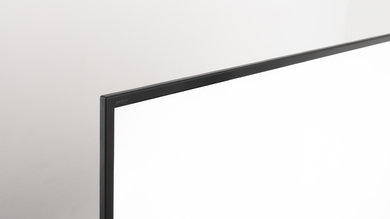
Borders 0.61" (1.6 cm)
The borders are most boilerplate, and aren't very distracting.

Max Thickness 3.fifteen" (eight.0 cm)
The X800G is a bit thicker than most TVs we've tested, and stands out a flake more when wall-mounted. It looks very similar to the X750F, and is quite a bit thicker than the X800E.

The Sony X800G has adept build quality. The external panels are a mix of metallic and plastic, and we didn't notice whatsoever issues or areas of concern. There is a slight backwards tilt on our unit of measurement; we don't know if this is a flaw with our unit, or intentional. Either way, it's very minor and not noticeable.
Film Quality
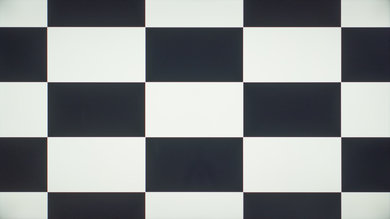
Native Contrast 977 : 1
Contrast with local dimming Northward/A
Update 07/11/2019: We take received information that the 75" model (XBR-75X800G) has a VA panel. Information technology likely has much better contrast.
Like the majority of IPS TVs, the X800G has a mediocre contrast ratio. This isn't very noticeable in a brilliant room, but when watching in a night room, blacks announced gray. Unfortunately, there is no local dimming characteristic to improve the contrast ratio.
Local Dimming No
Backlight Direct
The Sony XBR-55X800G does not have a local dimming feature. The above video is provided for reference only. According to Sony's website, the 43" and 49" models are edge lit.
SDR Real Scene Peak Brightness 291 cd/thousand²
SDR Peak 2% Window 333 cd/m²
SDR Elevation ten% Window 333 cd/m²
SDR Pinnacle 25% Window 333 cd/thou²
SDR Elevation fifty% Window 333 cd/m²
SDR Peak 100% Window 332 cd/thousand²
SDR Sustained two% Window 332 cd/1000²
SDR Sustained ten% Window 333 cd/m²
SDR Sustained 25% Window 332 cd/yard²
SDR Sustained 50% Window 332 cd/1000²
SDR Sustained 100% Window 332 cd/m²
SDR ABL 0.000
The X800G has good peak brightness in SDR, and is brighter than the X750F, only not quite as bright as the X800E. This TV is bright enough for well-nigh rooms, just might non be bright enough to overcome direct glare from a nearby window. There is no variation in effulgence with different content, which is slap-up.
We measured the acme effulgence subsequently calibration, using the 'Custom' Picture Way and the Color Temperature set to 'Skillful i'.
If accuracy isn't as important to you, with the 'Vivid' Picture Style, the X800G is able to achieve a height brightness of 440 cd/grand², as measured with the 100% window.
HDR Real Scene Peak Brightness 343 cd/g²
HDR Height 2% Window 393 cd/m²
HDR Peak 10% Window 394 cd/m²
HDR Peak 25% Window 394 cd/m²
HDR Top 50% Window 394 cd/k²
HDR Peak 100% Window 393 cd/thou²
HDR Sustained 2% Window 392 cd/m²
HDR Sustained 10% Window 394 cd/m²
HDR Sustained 25% Window 393 cd/m²
HDR Sustained 50% Window 393 cd/thou²
HDR Sustained 100% Window 393 cd/m²
HDR ABL 0.000
Decent HDR peak brightness, but bright highlights in some scenes don't stand out every bit much, as they aren't every bit vivid as they should be. Similar in SDR, the X800G is slightly brighter than the X750F, but not as brilliant every bit the X800E.
We measured the peak brightness before calibration, using the 'Movie theatre Pro' Picture show Style and the Color Temperature set to 'Proficient 2'.
If accurateness isn't as of import to yous, with the 'Vivid' Pic Mode and Adv. Dissimilarity Enhancer on 'Loftier' , the X800G is able to reach a superlative effulgence of 470 cd/m², as measured with the 50% window.
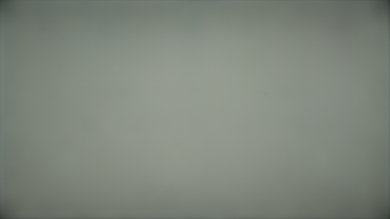
fifty% Std. Dev. 5.255%
50% DSE 0.188%

5% Std. Dev. 0.728%
five% DSE 0.120%
Decent gray uniformity. At that place is noticeable vignetting, only the centre of the screen has better uniformity. In nigh-dark scenes the uniformity is much improve, and in that location are few noticeable bug.
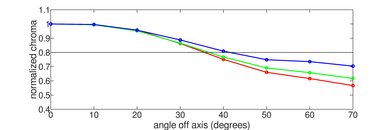
Colour Washout 36°

Color Shift 55°
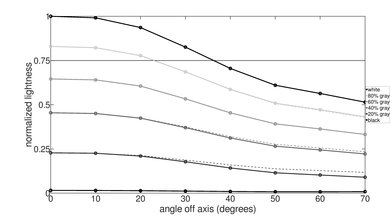
Brightness Loss 37°
Blackness Level Enhance lxx°
Gamma Shift 44°
Update 07/11/2019: We have received information that the 75" model (XBR-75X800G) has a VA panel. It probable has a worse viewing bending.
Similar most IPS TVs, the X800G has very practiced viewing angles. At wide angles, the image loses brightness, and the paradigm gradually looks more and more done out. Colors gradually wash out, but remain authentic until a very wide angle. Its successor, the Sony X800H, has much better viewing angles.
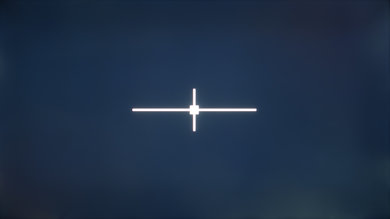
Native Std. Dev. two.230%
Std. Dev. w/ L.D. N/A
Update 07/11/2019: Nosotros take received information that the 75" model (XBR-75X800G) has a VA panel. It likely has much better black uniformity.
The Sony X800G has disappointing black uniformity. There is noticeable clouding around our test cantankerous, covering well-nigh the entire screen. Unfortunately, there is no local dimming feature.

Screen End Semi-gloss
Total Reflections 5.5%
Indirect Reflections 0.ii%
Calculated Directly Reflections 5.three%
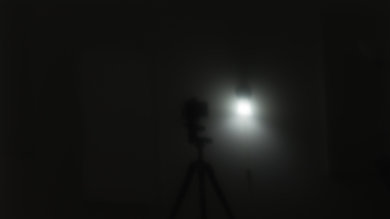
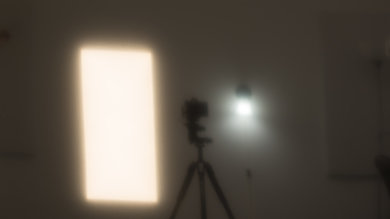
Very good reflection handling on the Sony XBR55X800G. Reflections are always noticeable, and are never fully diffused across the screen, but shouldn't crusade also many bug.
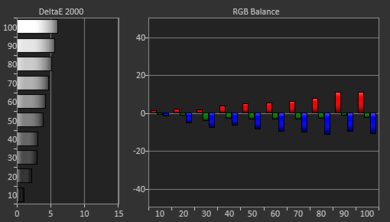

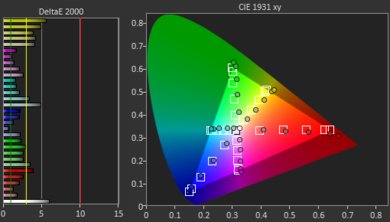
White Residuum dE three.90
Color dE 2.78
Gamma 2.22
Color Temperature 5,809 Thou
Picture Mode Custom
Color Temp Setting Proficient 1
Gamma Setting 0
With our pre-calibration settings, the X800G has decent accurateness. There are some noticeable errors in almost all colors, as well equally brighter shades of gray. Gamma is very shut to the target of 2.2, which is smashing.
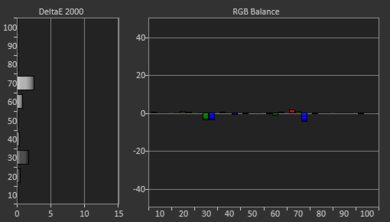
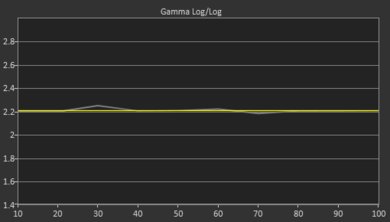
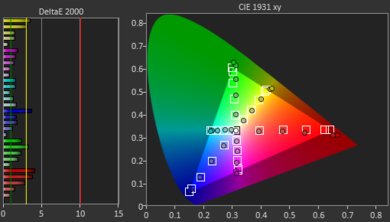
White Balance dE 0.lxx
Color dE i.87
Gamma 2.twenty
Color Temperature 6,443 K
White Rest Scale x point
Color Calibration No
Auto-Calibration Function No
Later scale, colors are more accurate, and the white balance is significantly improved. There are still a few inaccuracies that some people might find, only overall accurateness is excellent. Gamma is virtually perfect, and the color temperature is much closer to our target of 6500 G.
See our recommended settings here.

480p content, like DVDs, looks bully, with no obvious artifacts or problems.

720p content looks great, with no noticeable problems.

1080p content looks splendid, nigh every bit good as native 4k content. Nearest-neighbor upscaling is available for 1080p content, past selecting the 'Graphics' Picture Mode

4k content is displayed perfectly, with no pixel artifacts or rendering issues.
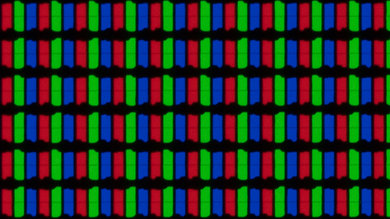
Different the X800E, this Television uses a PLS (Plane-to-Line-Switching) panel, similar to the X750F. PLS is technically different, merely similar, to IPS.
Wide Color Gamut Yes
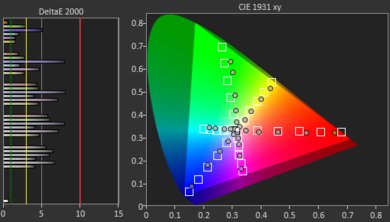
DCI P3 xy 84.48%
DCI P3 uv 91.64%
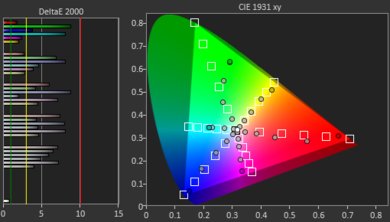
Rec 2020 xy 61.43%
Rec 2020 uv 68.xiv%
The Sony X800G has a adept color gamut, and unlike the X750F, it can display a wide color gamut, which is great for HDR content.
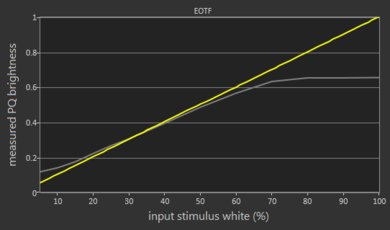
The HDR EOTF follows the target PQ curve well, just like many Sony TVs, including the X800E and X750F, dark scenes are over-brightened a flake. In 'Game' mode, the EOTF is nearly identical.
If you find HDR too dim, check out our recommended settings hither. With these settings, HDR content appears much brighter on the X800G, as shown here.
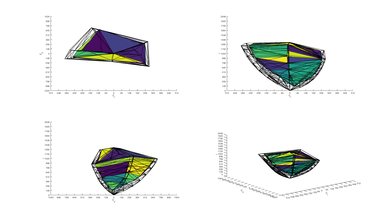
Normalized DCI P3 Coverage ITP 66.vi%
10,000 cd/m² DCI P3 Coverage ITP 29.3%

Normalized Rec 2020 Coverage ITP 54.i%
ten,000 cd/m² Rec 2020 Coverage ITP 23.7%
Mediocre color volume. It tin can't display deep, saturated colors due to the low contrast ratio, and similar most LED TVs, it can't produce very vivid blues, although this shouldn't exist very noticeable.
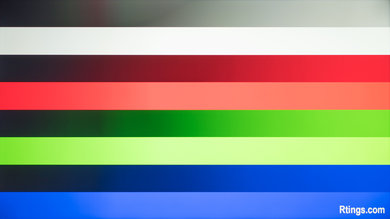
Color Depth 10 Bit
Crimson (Std. Dev.) 0.120
Green (Std. Dev.) 0.114
Blue (Std. Dev.) 0.102
Greyness (Std. Dev.) 0.092
Great gradient performance, but there is noticeable banding in all colors, especially in greens and shades of gray. Unfortunately, at that place is no polish gradation characteristic to remove any imperfections.

IR after 0 min recovery 0.00%
IR later on 2 min recovery 0.00%
IR after iv min recovery 0.00%
IR afterward 6 min recovery 0.00%
IR after eight min recovery 0.00%
IR after 10 min recovery 0.00%
There are no signs of temporary paradigm retention, even immediately after displaying our high-dissimilarity static test image for 10 minutes, which is great.
Nosotros don't know why the image appears red. Information technology isn't as cerise in existent life, and we suspect that this is an issue with the color temperature irresolute at low brightness levels, which is exaggerated past our over-exposed image.
We did observe a persistent flicker afterwards displaying content with a flicker in it. This is similar to what we saw on the LG 27UK650. Although not very noticeable with most content, it might be noticeable in some rare cases.
Permanent Burn-In Risk No
Although some IPS panels can suffer from temporary image memory, this doesn't announced to be permanent as seen in our long-term test.
Motion

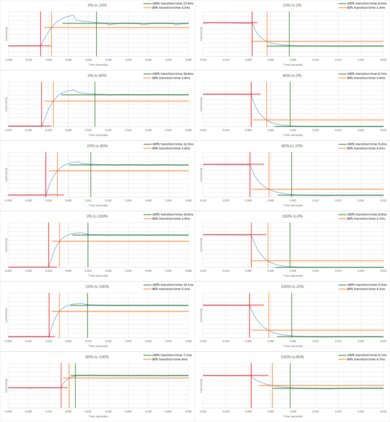
80% Response Time four.6 ms
100% Response Fourth dimension 14.vi ms
The X800G has a bully response fourth dimension, just some transitions show some overshoot, which can cause inverse ghosting, which can be particularly noticeable in dark scenes.
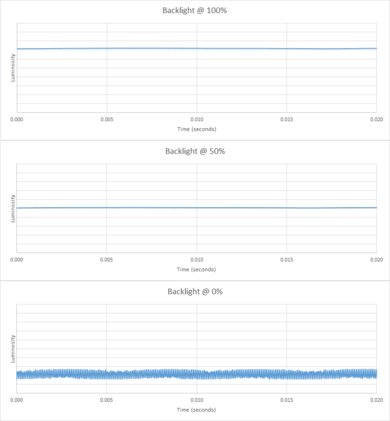
Flicker-Complimentary No
PWM Dimming Frequency 0 Hz
This TV doesn't use flicker to dim the backlight, which is not bad, but it isn't technically flicker-gratuitous, as at that place is a very high frequency flicker at low backlight settings. This flicker is very mutual on Sony TVs, including the X800E and X750F, and isn't noticeable.

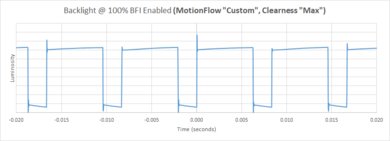
Optional BFI Yes
Min Flicker for 60 fps 120 Hz
60 Hz for 60 fps No
120 Hz for 120 fps N/A
Min Flicker for lx fps in Game Mode 120 Hz
The Sony X800G has an optional black frame insertion feature that can help ameliorate the appearance of motion, past reducing the corporeality of time each frame appears on screen. Similar the X800E, information technology can merely flicker at 120Hz, which causes duplications in 60Hz content, which might bother some people.

Motion Interpolation (30 fps) Yes
Motion Interpolation (lx fps) No
The X800G has a 60Hz panel, and can interpolate lower frame rate content up to 60Hz. Some artifacts are noticeable in intense scenes, but information technology looks smooth.
See hither for the settings that control the X800G'southward motion interpolation characteristic.
Frame Concord Time @ 24 fps 27.1 ms
Frame Agree Fourth dimension @ lx fps 2.1 ms
Since this TV has a slightly slower response time, there is less noticeable stutter when watching 24p content, like movies.
Judder-Gratis 24p Yeah
Judder-Free 24p via 60p No
Judder-Free 24p via 60i No
Judder-Free 24p via Native Apps No
The X800G tin can only remove judder from native 24p sources, and does not require whatever boosted settings to do so. Information technology tin't remove judder from the native apps, or from 60p/i sources, like a cablevision box.
Native Refresh Rate lx Hz
Variable Refresh Rate No
HDMI Forum VRR No
FreeSync No
Grand-SYNC Uniform No
4k VRR Maximum N/A
4k VRR Minimum No VRR support
1080p VRR Maximum N/A
1080p VRR Minimum No VRR support
1440p VRR Maximum Northward/A
1440p VRR Minimum No VRR support
VRR Supported Connectors No VRR support
The Sony XBR-55X800G has a unproblematic 60Hz refresh rate, and doesn't back up whatever of the variable refresh charge per unit technologies, like FreeSync or HDMI Forum VRR.
Inputs
1080p @ threescore Hz 32.5 ms
1080p @ sixty Hz Exterior Game Way 65.8 ms
1440p @ 60 Hz 34.iv ms
4k @ 60 Hz 34.5 ms
4k @ lx Hz + 10 bit HDR 34.5 ms
4k @ 60 Hz @ 4:4:4 34.5 ms
4k @ 60 Hz Outside Game Fashion 51.2 ms
4k @ 60 Hz With Interpolation 67.8 ms
8k @ 60 Hz Due north/A
1080p @ 120 Hz N/A
1440p @ 120 Hz N/A
4k @ 120 Hz N/A
1080p with Variable Refresh Rate N/A
1440p with VRR N/A
4k with VRR Northward/A
8k with VRR N/A
Auto Low Latency Mode (ALLM) No
The Sony XBR55X800G has very good input lag in Game mode, expert enough for slower-paced games, only it is higher than almost similar TVs currently on the market, and information technology might disappoint more serious gamers.
1080p @ threescore Hz @ 4:4:4 Aye
1080p @ 120 Hz No
1440p @ threescore Hz Yes (forced resolution required)
1440p @ 120 Hz No
4k @ lx Hz Aye
4k @ sixty Hz @ 4:4:4 Yep
4k @ 120 Hz No
8k @ 30 Hz or 24 Hz No
8k @ 60 Hz No
The X800G supports many of the more than mutual formats, but is limited to 60Hz. All supported resolutions brandish chroma 4:4:four properly, but only on HDMI ports 2 & 3, and with the 'Game' or 'Graphics' Picture Fashion. Similar many other Sony TVs, these two ports are the merely total bandwidth ports.
Like the X750F, when using the 'Graphics' Picture Mode the X800G uses nearest neighbor upscaling when sent a 1080p signal.


HDMI iv
USB 3
Digital Optical Sound Out one
Analog Audio Out three.5mm 1
Analog Audio Out RCA 0
Component In 1 (shared)
Composite In 1 (shared)
Tuner (Cablevision/Ant) 1
Ethernet one
DisplayPort 0
IR In 1
SD/SDHC 0
The analog audio out port tin besides be used equally a subwoofer port.
HDR10 Yes
HDR10+ No
Dolby Vision No
HLG Yep
3D No
HDMI 2.0 Full Bandwidth Yep (HDMI two, 3)
HDMI two.one No
CEC Yeah
HDCP 2.2 Yes (HDMI one,ii,3,4)
USB 3.0 Yes (1)
Variable Analog Audio Out Aye
Wi-Fi Support Aye (2.4 GHz, 5 GHz)
Dissimilar more advanced Sony TVs, this Telly does not support Dolby Vision HDR. Sony advertises this Television set as HDCP ii.3 compliant, merely we don't currently have a way to exam for this.
ARC Yes (HDMI 3)
eARC back up No
Dolby Atmos via TrueHD via eARC No
DTS:X via DTS-HD MA via eARC No
5.i Dolby Digital via ARC Yes
5.i DTS via ARC Yes
five.1 Dolby Digital via Optical Aye
five.1 DTS via Optical Aye
Like the Sony A8G, this Idiot box tin can play lossy Dolby Atmos as a Dolby Digital Plus signal from the native Apps, including Netflix.
This Television receiver does not back up eARC.
Sound Quality
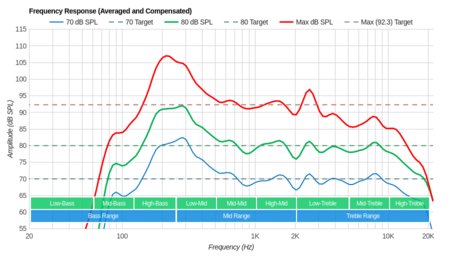
Low-Frequency Extension 134.54 Hz
Std. Dev. @ 70 4.23 dB
Std. Dev. @ 80 4.44 dB
Std. Dev. @ Max half-dozen.23 dB
Max 92.3 dB SPL
Dynamic Range Compression iii.49 dB
Mediocre frequency response on this Idiot box. The Depression-Frequency Extension is bad, at about 134Hz, which indicates that the bass produces no thump or rumble, and has virtually no punch. The frequency response above the LFE is very adept and apartment, which is important for clear and intelligible dialog. This TV tin go quite loud, without producing too much compression and pumping artifacts, which is great.
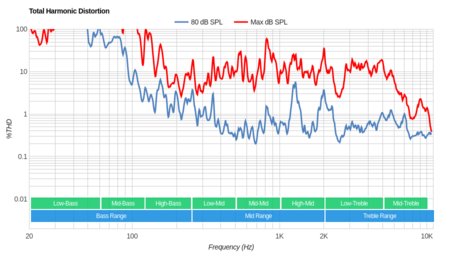
Weighted THD @ 80 0.105
Weighted THD @ Max 14.577
IMD @ eighty 3.33%
IMD @ Max 34.83%
The baloney functioning of this Idiot box is mediocre. At lower volume levels, the total baloney is adept, and not very noticeable, but at max volume the total distortion increases drastically and is much more noticeable.
Smart Features
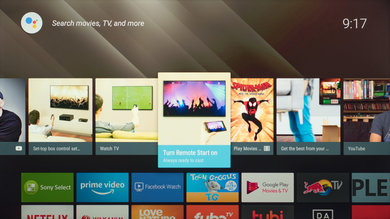
Smart OS Android TV
Version 7.0
Ease of Use Average
Smoothness Not Smooth
Time Taken to Select YouTube four s
Time Taken to Alter Backlight v s
Advanced Options Many
Like the A8G, the X800G ships with Android 7.0, which is strange, as older Sony TVs have already been updated to Android 8.0. The vii.0 interface is well organized, but information technology isn't smooth, and some bones tasks take longer to do than on Android 8.0.
The Android 8.0 update has started rolling out in batches, depending on the Television set's serial number. Once our unit receives the update, we will update our review.
Ads Aye
Opt-out No
Suggested Content in Home Yes
Opt-out of Suggested Content Yes
The interface is currently ad-complimentary, but once the Android 8.0 update rolls out nosotros wait there to be ads, as seen on the A9G. In that location is a row of suggested content at the moment, but this tin be completely disabled. Nosotros will update our review in one case the update has been installed.
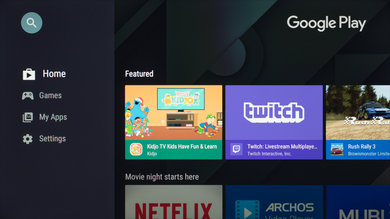
App Selection Great
App Smoothness Average
Bandage Capable Yes
USB Drive Playback Yes
USB Drive HDR Playback Yep
HDR in Netflix Yep
HDR in YouTube Yes
Like all Android TVs, this TV has an excellent choice of apps through the Google Play Shop.

Size Big
Voice Control Many Features
CEC Menu Command Yes
Other Smart Features No
Remote App Android Tv
The remote is the same basic Sony remote as older Sony TVs, and some 2019 models, including the A8G. This version of the remote requires direct line-of-sight to the TV, despite supporting Bluetooth connectivity, which is required for the integrated voice control feature.
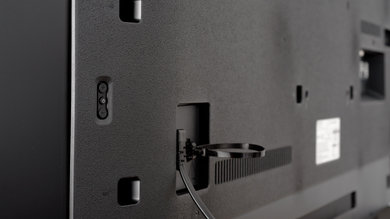
Like well-nigh Sony TVs, the physical controls are very simple, simply allow for basic control of the Boob tube.

- Quick-Start Guide
- Remote
- Batteries
- IR Blaster
Ability Consumption 55 W
Power Consumption (Max) 147 W
Firmware PKG6.6035.0229NAA
Differences Between Sizes And Variants
Nosotros tested the 55" X800G (XBR-55X800G), and nosotros expect our results to be valid for the 43" (XBR-43X800G), 49" (XBR-49X800G), 65" (XBR-65X800G), and 75" (XBR-75X800G) as well.
The 43" and 49" models are advertised by Sony as border-lit, which may affect some results.
If someone comes across a different type of console or if their Sony X800G doesn't correspond to our review, let u.s.a. know and we will update the review. Note that some tests such as the gray uniformity may vary between individual units.
| Size | United states of america Model | Alternative Proper noun | European union Model |
| 43" | XBR43X800G | XBR-43X800G | KD-43XG8096 |
| 49" | XBR49X800G | XBR-49X800G | KD-49XG8096 |
| 55" | XBR55X800G | XBR-55X800G | KD-55XG8096 |
| 65" | XBR65X800G | XBR-65X800G | KD-65XG8096 |
| 75" | XBR75X800G | XBR-75X800G | KD-75XG8096 |
Update 07/eleven/2019: We have received information that the 75" model (XBR-75X800G) has a VA panel. It likely has much better contrast and amend black uniformity, merely a worse viewing angle.
The X800G nosotros reviewed was manufactured in April 2019.
Compared To Other TVs

Peak left: LG UM7300 (55UM7300). Bottom left: Samsung RU7100 (UN55RU7100). Middle: Sony X800G (XBR-55X800G). Tiptop right: TCL vi Serial R617 (55R617). Lesser right: Hisense H8F (55H8F). Unlike our other photographs, this film wasn't taken nether a controlled surroundings, so do not draw conclusions from it.
The X800G is a basic 4k TV with decent performance. It is a minor upgrade over previous models. See our recommendations for the best TVs, the best smart TVs, and the best sounding TVs.
43" 49" 55" 65" 75" 85"
The Sony X800H is ameliorate than the Sony X800G. The X800H tin can become much brighter, the viewing angles are significantly amend, and there's minimal dirty screen effect, which is distracting with fast-moving objects. The X800G handles reflections slightly improve and the response time is slightly quicker, but the input lag is much lower on the X800H. Overall, the X800H is an improvement over its predecessor, the X800G.
43" 50" 55" 58" 65" 75" 82" 85"
The Samsung Q60/Q60T QLED is improve than the Sony X800G for most uses. The Samsung's VA panel has much better dark room operation, and its color accurateness and uniformity are besides a lot better. The Samsung has a higher acme brightness and lower input lag, but the Sony has a faster response time and better build quality.
49" 55" 65" 75" 85"
The Sony X900F and X800G utilise different panel types, each with their ain strengths and weaknesses, simply overall, the X900F is much better. The X800G uses an IPS panel, which delivers much wider viewing angles, but doesn't look every bit good in a dark room. The X900F, with its VA panel, looks amend in a dark room, as blacks await black. The X900F also has a decent local dimming system, is much brighter, and has a fast response time than the X800G. The X900F can remove judder from all sources, which the X800G tin can't exercise.
43" 49" 55" 65" 75" 82"
The Sony X800G and the Samsung Q60/Q60R QLED have different panel types, each with advantages and disadvantages. The Sony X850G uses an IPS panel, has much meliorate viewing angles, and better reflection treatment, which is nice for a bright, wide room. The Samsung Q60R has a VA panel that delivers a much better nighttime room performance. It has lower input lag and can remove 24p judder from any source. The Q60R as well supports FreeSync variable refresh rate and has low input lag with motion interpolation, which is great for gaming.
49" 55" 65" 75" 82" 85"
The Samsung Q70/Q70R QLED is a much better TV than the Sony X800G. The Samsung has much better blacks thanks to its VA panel and local dimming feature. It can as well get much brighter, especially for HDR content, has meliorate motion handling, and has more accurate colors out-of-the-box. On the other hand, the Sony's IPS panel gives it much better viewing angles.
55" 65" 75" 85"
The Sony X850G is amend than the Sony X800G. The X850G has better greyness uniformity, amend reflection treatment, and much lower input lag, for a more responsive gaming experience. The X850G tin can remove judder from all sources, and it can interpolate motion upwardly to 120Hz.
55" 65" 75" 85"
The Sony X950G is a much meliorate TV than the Sony X800G. The X950G has much deeper blacks, local dimming, much higher peak brightness, better black uniformity, better motion handling, and uses a newer and smoother version of Android Boob tube for its smart interface. On the other hand, the X800G has much wider viewing angles thanks to its IPS panel (in every size except 75").
49" 55" 65" 75"
The LG SM8600 is a ameliorate TV than the Sony X800G. Both TVs use an IPS panel, which results in mediocre contrast and bad black uniformity, just improves the viewing angle over a Telly with a VA panel. The LG has better reflection handling, a wider color gamut, better motion handling, and much lower input lag. On the other manus, the Sony is brighter, has more than accurate colors out-of-the-box, and has better viewing angles.
43" 49" 55"
The Sony X800G is slightly better than the X800E. These ii TVs were not evaluated using the same examination demote, and so it's hard to brand a direct comparison, just there are a few differences. The newer X800G has better motion handling due to a faster response time, has better black uniformity, and has ameliorate reflection handling.
43" 50" 55" 58" 65" 75"
The Samsung RU7100 and the Sony X800G use different panel types, each with their advantages and disadvantages. The RU7100 delivers better night room performance thanks to its VA console, simply the prototype degrades at an bending. The Sony X800G has wide viewing angles and is improve-suited for a broad room. The RU7100 also has much lower input lag, but can't remove judder from whatever source.
49" 55" 65" 75" 82"
The Samsung RU8000 and the Sony X800G use different console types, each with its advantages and disadvantages. The Samsung delivers amend dark room performance thanks to its VA panel, but the epitome loses accuracy at an angle. The Sony has wide viewing angles and is ameliorate suited for a wide seating arrangement. The Samsung also has a much lower input lag and is equipped with FreeSync support, which should please gamers.
55" 65"
The Sony X800G and LG B8 OLED employ dissimilar console technologies, each with advantages and disadvantages. The Sony has an IPS panel, and the brightness doesn't vary with content. The LG, on the other manus, can display perfect blacks in a night room thanks to the OLED panel. The LG also has a much faster response fourth dimension and delivers well-baked motility, but with more stutter. The Sony is immune to the risk of burn-in that the B8 has.
55" 65" 75"
The TCL 6 Series/R617 and the Sony X800G utilise dissimilar console types, each with dissimilar advantages and disadvantages. The X800G is meliorate for a bright room with wide seating, whereas the R617 is meliorate suited for straight seating in a dark room. Beyond these differences, the R617 is a lot brighter, has lower input lag, and can remove judder from any source.
43" 49" fifty" 55" 65"
The LG UM7300 is somewhat better than the Sony X800G. The LG can handle reflections better, which is great if your room has a lot of lights. The LG too has an extremely low input lag that'due south corking for gaming. The Sony, on the other hand, is flicker-free, which might be of import to some people.
40" 43" 43" 50" 55" 55" 60" 65" 65" lxx" 75"
The Vizio V Series 2019 and the Sony X800G are very similar overall, but utilise different panel types, each with their own strengths. The X800G is all-time suited for a vivid room with wide seating, as information technology doesn't look as good in a nighttime room. The V Series 2019 has ameliorate contrast and looks much ameliorate in a dark room, merely the image degrades at an bending, so it is best enjoyed from directly in front. Other than these differences due to the panel type, the X800G has improve motility handling, but the Vizio V Series has lower input lag.
43" l" 55"
The Sony X800G and the Toshiba Burn down TV 2019 are similar, but use dissimilar panel types, each with their ain strengths and weaknesses. The X800G uses an IPS panel and has much better viewing angles and a faster response fourth dimension. The Toshiba uses a VA panel, and has worse viewing angles but much better contrast.
65" 75" 85"
The Sony X850F is improve than the X800G, simply the differences might not matter as much for everyone. The X850F has ameliorate reflection handling, swell for bright rooms, and information technology can remove judder from all sources, whereas the X800G can only remove judder from true 24p sources.
+ Show more

Sony Kd 55 Xg 8096 Test,
Source: https://www.rtings.com/tv/reviews/sony/x800g
Posted by: ortizhalown42.blogspot.com
0 Response to "Sony Kd 55 Xg 8096 Test"
Post a Comment